Quick Summary
Does artificial grass increase home value? Industry data points to yes, with estimates ranging from 3% to 15% depending on market, climate, and installation quality, and most homeowners recovering their investment within three to five years through eliminated lawn care costs alone. This guide breaks down the actual ROI numbers, what real estate data shows about buyer behavior, and the specific factors that determine whether a synthetic lawn becomes a selling point or a liability when your home goes on the market.
If you're searching for a real answer to whether artificial turf installation is worth it financially, not just a list of lifestyle perks, you're in the right place. This guide pulls together the actual percentage estimates from real estate research, breaks down the math on payback period, and looks at the question from the buyer's side of the table, because how a prospective buyer reacts to synthetic turf matters just as much as how much it costs to install.
Does Artificial Grass Increase Home Value? What the Data Shows
The short answer is yes, in most markets, though the exact number depends heavily on location and execution. Here's what the data actually shows:
- Industry estimates place the home value increase from quality artificial turf at 3% to 10% in markets where water conservation and low maintenance are valued by buyers, and as high as 7% to 15% in some real estate analyses factoring in broader landscaping ROI
- Professional landscaping more broadly, which synthetic turf falls under as a category, has been shown to add 15% to 20% to resale value when done well
- Properties with quality artificial turf installations have been reported to sell 1% to 5% higher than comparable homes in the same neighborhood
- The typical payback period for residential turf is 3 to 5 years, after which the investment is generating pure savings rather than just offsetting installation cost
To put a number on this: on a $600,000 home, a 3% to 10% value increase translates to $18,000 to $60,000 in additional market value. Even at the conservative end of that range, the math clears the cost of a typical residential installation by a wide margin.
It's worth being direct about the caveat here: these are industry estimates and market-level trends, not a guarantee for any individual home. Local climate, neighborhood norms, and installation quality all swing the actual outcome significantly, which is exactly why the rest of this guide breaks those factors down.
A home in a drought-affected region with high water restrictions will generally see a stronger value bump than one in a climate where natural grass thrives easily and water is inexpensive. Appraisers and real estate agents also weigh landscaping differently depending on local buyer expectations, so the safest approach is treating these figures as a realistic range rather than a fixed guarantee.
The ROI Math: Installation Cost vs. Long-Term Savings
Looking at artificial turf purely as a value-add undersells the financial case. The stronger argument comes from combining home value increase with what you stop spending every year.
What natural grass costs annually:
- Water: irrigation for a typical lawn can run several hundred to over a thousand dollars per year depending on climate and lawn size
- Mowing, fertilizer, and weed treatment: commonly $1,500 to $3,000+ per year when professional lawn care is factored in
- Reseeding, aeration, and seasonal repair: additional recurring cost, especially in regions with harsh winters
- Equipment ownership or rental for homeowners handling maintenance themselves, plus the time cost of weekly mowing across an entire growing season
What artificial turf eliminates: nearly all of the above, replaced with minimal occasional maintenance, typically under an hour a month.
Stack the annual savings against the upfront cost and most homeowners land on a 3 to 5 year payback period. Every year after that is value retained, not spent, on top of whatever resale premium the improvement adds when the home eventually sells. This is the part of the home value conversation that purely lifestyle-focused articles tend to skip, and it's worth running the numbers for your specific lawn size and local water rates before assuming the investment is purely cosmetic. A free site assessment is the fastest way to get real numbers specific to your property rather than relying on national averages.
The Buyer's Perspective: What Actually Moves a Sale
Real estate value isn't just about what a feature costs to install. It's about how a buyer reacts when they see it, and that reaction depends on factors that have nothing to do with the percentage estimates above. A buyer touring a home doesn't see a statistic; they see a yard, and their gut reaction to that yard shapes how they perceive the rest of the property. Here's what tends to matter from that side of the table.
First impressions happen before the front door.
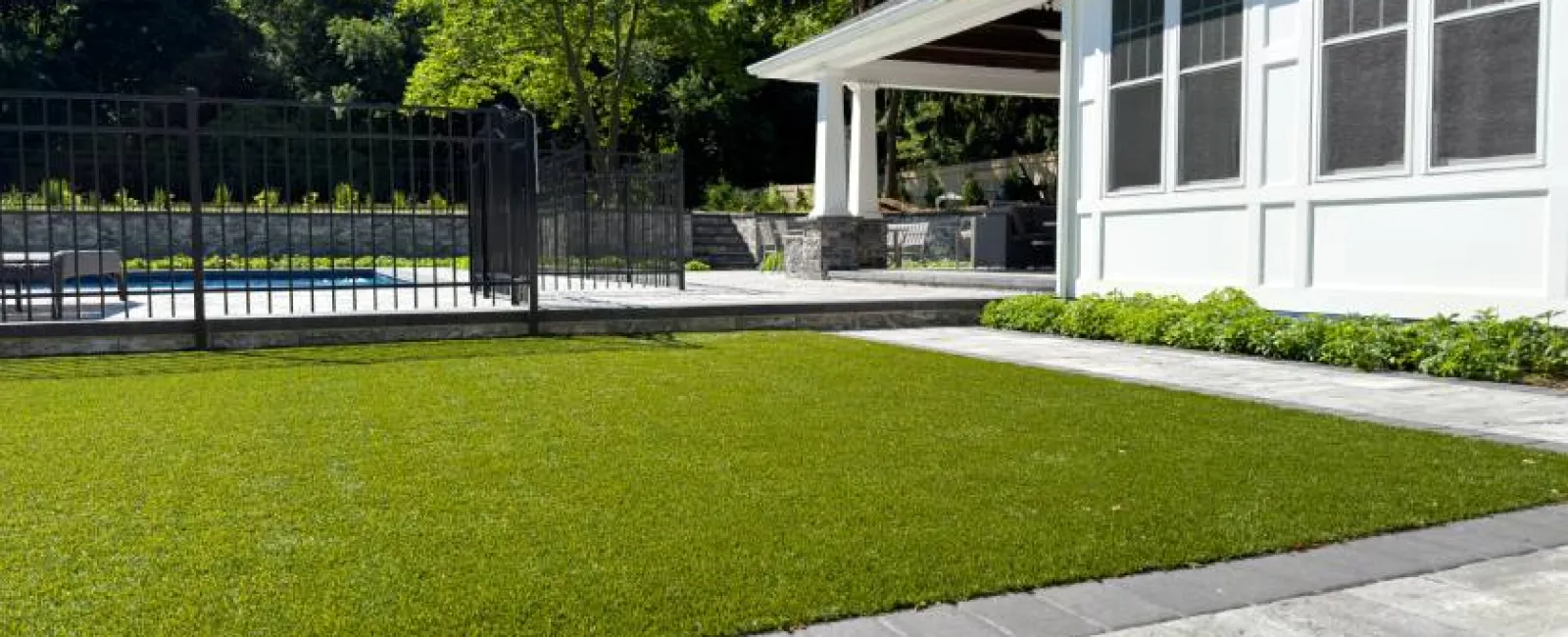
Curb appeal determines whether a buyer is excited to walk inside or already mentally listing concerns. A patchy, brown, or weed-choked lawn signals neglect, even if the rest of the home is in excellent condition. A clean, consistently green yard does the opposite, and it does it in every listing photo regardless of when those photos were taken.
Buyers increasingly read low-maintenance as a selling point, not a gimmick.
A decade ago, artificial turf carried a stigma in some markets. That perception has shifted considerably as quality has improved and water costs have risen in many regions. Buyers in busy households, secondary homeowners, and anyone who has dealt with the time cost of lawn care tend to view a well-installed synthetic lawn as a genuine convenience upgrade rather than a red flag.
Quality is the deciding factor in buyer perception.
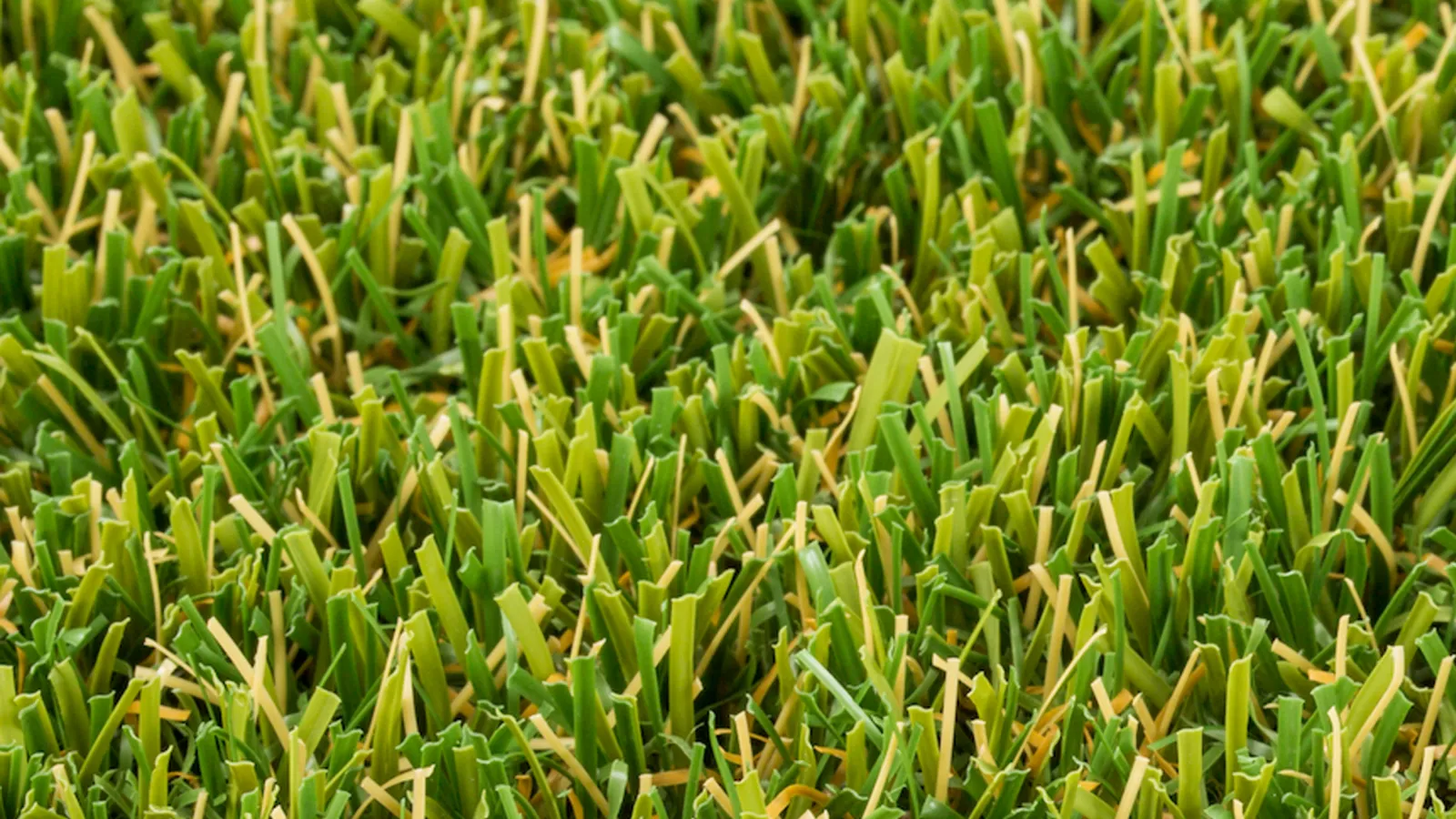
This is the single biggest variable in whether turf helps or hurts a sale. Outdated, overly uniform, or visibly artificial-looking turf can actually work against a listing. Multi-tone, realistic blade construction with proper installation, no visible seams, no wrinkling, no drainage issues, reads as a premium upgrade. Cheap or poorly installed turf reads as a problem the new owner will have to deal with.
Faster time on market.
Homes that show well consistently, regardless of season or weather right before a showing, tend to move faster. A natural lawn that happens to be patchy the week photos are taken can cost a seller real momentum. A synthetic lawn looks the same in January as it does in July.
Neighborhood context matters.
In a neighborhood where every home has a manicured natural lawn, a tasteful synthetic lawn that matches the aesthetic still stands out positively for its consistency. In HOA-governed communities, it's worth confirming turf is permitted and meets any aesthetic guidelines before installing with resale in mind.
What Determines Whether Turf Helps or Hurts Resale Value
Not every artificial grass installation adds value. Some genuinely subtract from it. These are the factors that separate a smart investment from a wasted one, and they're worth evaluating honestly before assuming any turf project will automatically pay off.
Installation quality.
Visible seams, wrinkling, or poor drainage are immediately apparent to a buyer or inspector and undercut the entire premise of a low-maintenance upgrade. A professionally installed lawn with proper base preparation avoids these issues entirely.
Material realism.
Multi-tone blade coloring and realistic thatch layers look dramatically more natural than older, flat-green, single-tone turf products. This single factor heavily influences whether a buyer perceives the lawn as an upgrade or a downgrade.
Climate and local water costs.
In regions with high water costs or drought restrictions, the ROI case is considerably stronger because buyers actively price in ongoing water savings. In milder climates with abundant rainfall, the value-add still exists but the urgency is somewhat lower.
Application beyond just the front lawn.
Adding functional features like a pet area or a putting green tends to push perceived value higher than turf alone, since these appeal to specific buyer lifestyles rather than just solving a maintenance problem.
Considering Artificial Turf as a Home Value Investment?
Turf Tek USA installs premium, multi-tone synthetic turf engineered to look natural and last for many years, the kind of quality that reads as a genuine upgrade to buyers rather than a corner-cutting shortcut.
Serving Long Island, New York, Westchester, and the surrounding Northeast region, we help homeowners get a lawn that looks great immediately and holds its value over time. Call (631) 651-5777 or contact us for a free site visit and estimate.